Your Ad Here
Showing posts with label Tihar Jail. Show all posts

Thursday, 1 September 2011

Self-centred? Delhi finds new identity, soul with Anna's movement


NEW DELHI: The fast began in Tihar jail on Tuesday. By the time the police agreed to the terms set by Anna Hazare, Friday had arrived. Thousands flooded Ramlila Maidan where the social activist had been permitted to stage his protest. The cynics predicted that the crowd would peak during the weekend and peter out the following week.

They were wrong. The multitude held firm through the week. They shouted pungent slogans (Saare yuva yahaan hain, Rahul Gandhi kahaan hai?), waved the tricolor, danced in sunshine and sang in rain. Across the city, RWAs brought out small candlelight demonstrations. Artists sprayed graffiti. Barring one minor late night incident, there wasn't a single incident of violence: no destruction of public property, no molestation or eve-teasing.

In a venue poised between two Delhis - the old and the new - the city and its citizens surprised everybody with a kind of new collective behaviour. This was a different Delhi on display. "There seems to be a new consciousness about setting and following norms of self-governance and self-discipline, especially in public spaces," says sociologist Yogendra Singh.

For decades, Delhi has been reviled as a self-centred city which often turned violent. To many, the city, celebrating its 100th year since the national capital moved here, personified the paradox of being India's political centre yet playing host to 17 million apolitical people.

The allegation was partly justified. In the 1990s and earlier, Delhi was primarily an unwilling, resentful recipient of political rallies. The Mandal agitation was a possible exception. But it was violent and destructive. But this was different.

As columnist Santosh Desai puts it, "People are finally beginning to take responsibility for something larger than themselves. There is a positive change in the city's social behaviour."

Changes are processes, not incidents. But perhaps February 21, 2006 is a crucial date in the social evolution of Delhi. That was the day the city discovered that no one had killed Jessica Lall. That judgment was a shock therapy to a people for whom apathy was the norm. The case gave them a cause to campaign for.

Since that day, many stopped being fence sitters. That was perhaps the beginning of Dilliwallahs redefining their own engagement with society. The change was also evident in the reaction to the Priyardarshini Mattoo case -- a law student stalked and murdered by fellow student Santosh Singh. A public campaign forced a retrial, ultimately leading to Santosh's conviction.

Perhaps Delhi has changed more than we have noticed or bothered to examine. The absence of eve-teasing during the all-night World Cup 2011 win celebrations across the city or during the anti-corruption movement weren't aberrations. Rather they encapsulated larger city trends: between 2006 and 2009, eve-teasing dropped by 57% and women molestation by 23%, police records show.

Desai feels that the change has come with a much easier relationship of genders. "There are more platforms for social interaction," he says. With easy availability of technology, fantasy has given way to access and reality. You don't just stare at the girl; you just send an sms.

SMS are GenNow tools of political mobilization too. What started off with sending SMSs and chain mails, forming online groups and bringing out candlelight demonstrations has since blossomed into a larger social and political awareness. Neelam Katara, whose son was killed by a strongman politician's son, says, "During my fight, I got a lot of support from the common people."

The Anna anti-corruption movement was more expansive in content and an amalgam of different social groups. Be it traders who served free snacks or the frail old man who went around distributing water, it showed a larger band of citizenry rubbing shoulders with the more privileged social groups for a common cause. The young were more prominent but the old were present in big numbers too.

That's perhaps why 24-year-old computer engineer Abhinav Sharma is at a loss to explain his experience. "For the first time I saw people from different classes sharing jokes, food, slogans. I had never imagined something like this could happen in Delhi," he says.

The changes are evident in non-political events too. Desai recalls how college festivals, especially rock shows, ended up in brawls where somebody would invariably draw a knife or a gun. "Now such instances are much fewer because the young get more occasions to interact. Collective rowdiness has dipped," says Desai.

In 1947, Delhi became home to lakhs of refugees from the other side of the fence. Social scientist Ashis Nandy says that the refugees in post-Partition Delhi, as literature on them suggests, had certain traits. They were tough-minded and self-centred; many were wheeler-dealers, prone to violence. "But those characteristics have softened after a generational change," he says.

Part of the change possibly has also been prompted by a steady migration from different states - both of professionals as well as labourers. Together, they have created a more diverse city. "Delhi was like a district town. Finally, it is becoming a metropolitan city. There's a maturing of sorts," says Nandy.

Freelance sound recordist Asheesh Pandya, a Ramlila Maidan regular, echoes a similar view, "The average Dilliwallah is more politically conscious and socially aware than say, five years back."

Yogendra Singh says that the media too has played a role in raising the confidence of the citizenry. "Over the past decade, newspapers have also become vehicles to highlight and underline the needs and grievances of the middle-class, rather than merely represent political discourses. It has helped in empowering and enabling them; the crowd in Ramlila maidan was self-assured in its strength," he says.

It is possible that Delhi's story isn't just that of a city but the story of a nation. The India narrative post-1991 is often divided into two categories: India Shining and India Invisible. Perhaps Delhi, like many other cities, towns and qasbahs, is witnessing the emergence of a third India that acts as a bridge between the two, which has its foot in both, but which has an identity of its own.

Monday, 22 August 2011

What Anna Hazare does when he's not on stage?


NEW DELHI: Well before he comes before the people every morning at the Ramlila Ground, Anna Hazare locks himself in a 10x10 feet makeshift room backstage and writes in meditative silence for over two hours. It is an activity he's particular about.

Though the activist abstains from his routine yoga during fasts, writing is one thing he never compromises on, Suresh Pathare, a Hazare confidant who is from his Ralegan-Siddhi village in Maharashtra, said.

His schedule during his hunger strike, which entered the seventh day on Monday, goes something like this.

The 74-year-old wakes up at 6.30am in a room hidden behind the grand stage. He takes about an hour to get ready. Shaving is a must, "a habit from his military days", says Pathare, who has been with Hazare for about 10 years.

An hour later, he gets down to writing.

What does he write? "About little things, humanity, rights... He puts on paper a lot of internal thoughts," says Pathare, 31.

"Even in Tihar (Jail), he used to write a lot. In jail he used to read newspapers and watch news on TV, but here he just writes."

Pathare added: "In the village, he sometimes doesn't come out of his house for days. No one has the guts to knock on his door.

"If someone has to bring him food, he'll keep it outside and leave. No one can dare to disturb him."

Pathare first met Hazare during a rural development project in the village. He has since become his loyal aide.

It is only at around 10am that Hazare appears before the waiting crowd, which bursts into a prolonged applause on seeing the former soldier who ferried supplies to the frontlines in the Indian Army.

He stays on the stage till 9pm, sometimes sitting in an upright posture and sometimes taking help of the bolster to give his body some stretch.

The gathering keeps a steady chant of slogans hailing him. He faintly smiles. Occasionally that he picks up a mike and addresses the crowds.

A portable toilet is placed next to his makeshift room. Doctors check him every three hours.

At around 10pm, the activist calls it a day and retires to his room.

"Anna likes to sleep at the venue when he's fasting," said Pathare, who has been with Hazare during all his last 10 fasts in the past decade.

However, during the five-day fast at Jantar Mantar here, Hazare used fellow activist Swami Agnivesh's home nearby to get fresh.

Besides the multiple medical check-ups daily, a 24-hour ambulance is parked outside Hazare's night shelter.

Balram Gupta, a doctor from Medanta Medicity, told IANS: "His blood pressure, heart rate, everything is fine. He's a very tolerant man."

Volunteers are parked behind the stage.

Around 300-400 activists are deployed at the ground, which is bigger than a football field, apart from police force.

Hazare's meetings are restricted to close aides and special guests.

Pathare said that Hazare was very particular about time.

"If he has two back-to-back engagements and the first function stretches on a little and he gets late for the second meeting, he gets very angry," he said.

Aswathi Muralitharan, who has been with India Against Corruption (IAC) for two years, reveals another Hazare characteristic.

"He will never sign a document without going through it. He'd check it 100 times and make at least 50 changes. No one can impose anything on him."

Adds Pathare: "He writes, rewrites, improvising again and again, till he's satisfied. He's a perfectionist."

No single solution to tackle problem of corruption: Manmohan


The Prime Minister said creation of Lokpal as an institution would not solve the problem and reiterated that there was no 'magic wand' to remove corruption.


With Team Anna stepping up the heat on the corruption issue, Prime Minister Manmohan Singh on Monday said the government was open to reasoned debate on the Lokpal Bill but made it clear that there was no single solution to tackle the problem.

“We have introduced the bill in Parliament which is now before the standing committee. There are differences of views on details of the bill,” Dr. Singh said at the golden jubilee function of the Indian Institute of Management here.

“We have made it clear that all concerned individuals should convey their concern on different aspects of the bill to their representatives in Parliament and to the standing committee”, he said.

Dr. Singh said, “We are open to a reasoned debate on all these issues”.

Recalling his Independence Day address, Dr. Singh said, “I said (in my speech) that there is no magic wand that can solve the problem in one stroke. There is no single solution. We need to act on multiple fronts”.

He said that the creation of Lokpal as an institution would help but it would not solve the problem. “It needs to be supported by improvements in the pace and quality of judicial processes”.

He said that corruption has not disappeared from the system and it surfaces in many forms.

“The ‘aam aadmi’ faces corruption when he has to pay a bribe to facilitate ordinary transactions with the government”, the Prime Minister said.

“There is also corruption on a larger scale. Large government contracts can breed corruption when government procedures are inadequate”, he said.

He said that strong procedures were needed to eliminate corruption and the government was serious to remove it.

“It is a mistake to see corruption as a consequence of economic liberalisation and reforms, Dr. Singh said, adding “any area which has actually seen systematic reforms has seen disappearance of corruption.”

'Need to strengthen regulatory institutions'

The Prime Minister said many of the controversies that have arisen in the recent past were due to inadequacies of our regulatory institutions.

“We need to strengthen this regulatory framework, including strengthening their technical capacity”, he said.

The funding of elections and of political parties was another area calling for reforms to reduce the scope for generation of black money, he said.

Stressing the need to thoroughly revamp existing government procedures to reduce discretion and to make the basis of decision making as transparent as possible, the Prime minister said, “I have asked a group of Ministers to look into this issue and I am confident we will come up with systemic solution“.

He urged the IIM students to contribute as managers to the process by suggesting mechanisms that would increase transparency.

Pointing out that many countries have a law to govern government procurement, he said, “We propose to introduce legislation along these lines. The United Nations Commission on International Trade Law has recently modified its earlier model procurement law. We can benefit from this latest model law and internalise international best practices.

“I would urge state governments to do the same”, he said.

He said, “A comprehensive restructuring of government system and procedures along these lines is necessary if we want to clean up the system. Clean it up we must“.

Observing that economic reforms were aimed at unleashing India’s enormous entrepreneurial potential to accelerate the pace of economic development, Dr. Singh said, “Along with the techno-economic issues which we deal with in our planning process, we also need to change our system of governance to eliminate corruption. It will take time and effort but it can be done”

Sunday, 21 August 2011

Sarangi meets Hazare to find points of consensus and defuse crisis


Maharashtra Additional Chief Secretary (Home) Umesh Chandra Sarangi met social activist Anna Hazare in New Delhi to find points of consensus and defuse the situation in the face of the overwhelming support for the Jan Lokpal Bill.

Mr. Sarangi, who was called to Delhi on Thursday, met Mr. Hazare twice. He confirmed to a TV channel that he did meet Anna and enquire about his health. He did not elaborate about the talks. Mr. Sarangi, who shares a good rapport with Mr. Hazare, has dealt with him closely over the past decade.

A Congress party source confirmed the meeting and said that Mr. Sarangi was perhaps the best man to talk to Mr. Hazare since he was Principal Secretary to the former Chief Minister, Vilasrao Deshmukh, and had dealt with Mr. Hazare during that period. Prior to that, Mr. Sarangi was Commissioner, Cooperation and Registrar of Cooperative Societies, a subject against which Mr. Hazare has raised many issues of corruption and fraud, forcing the government to take cognisance of his complaints.

Mr. Sarangi was involved in talks with Mr. Hazare, mediating on several issues when he was the former Divisional Commissioner of Pune. Often he would be sent to understand Mr. Hazare's demands and place them before the Chief Minister so that a solution could be found.

A native of Orissa, Mr. Sarangi, with a 30-year career, also served as the former Chairperson of the National Bank for Agriculture and Rural Development. The Centre was looking for a person who could talk with Mr. Hazare and meet him on a one-on-one basis. There was a growing concern in Maharashtra about his health as well, said a political observer.

There is a feeling in the Congress that Mr. Hazare is a reasonable person and has, in the past, been open to discussion and negotiation. Mr. Sarangi will have to rely on his intricate knowledge about mediating in Mr. Hazare's agitations from the past to understand where some middle ground can be found.

The Congress also feels that the need of the hour is consensus and not confrontation and sending Mr. Sarangi to meet Mr. Hazare is a step in that direction. The Central government has already made a public announcement that any citizen can come before the Parliamentary Standing Committee on the Jan Lokpal Bill and offer suggestions, a move clearly aimed at involving the people.

However, there is a feeling within the Congress that Mr. Hazare is surrounded by a group which seems to be intransigent and even the National Campaign for People's Right to Information had expressed reservations about the methods adopted by Anna and his supporters.

Team Anna to govt.: Withdraw Bill, will talk


Social activist Anna Hazare at the core committee
 meeting of the "India Against Corruption" movement
 during 6th day of his fast at Ramlila Ground in
New Delhi on Sunday

Team Anna on Sunday said the government should appoint a negotiator to hold talks with Anna Hazare on the Jan Lokpal Bill and withdraw its draft from Parliament to create “an atmosphere of trust”.

Swami Agnivesh, one of the members of Team Anna’s core committee, said they were open for talks but the government should create an atmosphere for it.

“If the government wants to talk to us it should appoint a negotiator,” he said.

“We are open for talks. In order to open a door for dialogue, the government has to create an atmosphere. They have to create an atmosphere of trust by withdrawing the government Bill from Parliament and introduce Jan Lokpal Bill. We will not budge from our stand. This is the least they should do to earn our trust,” Swami Agnivesh said.

To questions on “strong words” being used by both government and members of Team Anna, Swami Agnivesh said it would be good if both sides desist from using “such phrases” which could lead to any kind of confrontation.

On the meeting between senior Maharashtra government official and Mr. Hazare, he said the official has known the social activist for a long time and he met him in his personal capacity.

Saturday, 20 August 2011

Jammu shows solidarity with Hazare

Schoolboys hold a placard in support of anti-corruption activist Anna
 Hazare during a protest against corruption in Jammu on Saturday.

Even as Jammu showed solidarity with social activist Anna Hazare through rallies and demonstrations in the last five days, Kashmir continues to remain aloof of the crusade.

People gathered in small numbers in many areas of Jammu city, and in neighbouring towns and villages, to show support for Mr. Hazare's crusade against corruption.

The demonstrations saw the participation of social activists, students, professionals and traders.

Sangarsh RTI Movement leader Balvinder Singh said rallies would be organised here on Tuesday and Thursday under the banner of “India Against Corruption”.

In the Kashmir Valley, in contrast, there have been no rallies or demonstrations in support of Mr. Hazare. Analysts give varied reasons for this.

Political scientist Gull Mohammad Wani says the Indian civil society has by and large failed to “own any empathies with Kashmiris — particularly in the last 20 years.” “Hazare and his associates are not known to Kashmiris the way Jayprakash Narayan and Mridula Sarabhai are. They had supported the people of Kashmir in crucial political times.”

Convenor of Jammu and Kashmir RTI Movement Muzaffar Bhat, however, says that the Lokpal was irrelevant to the State as it could not be implemented here on account of Article 370.

Hard-line Hurriyat chairman Syed Ali Shah Geelani said, “The efforts by Hazare are futile and meaningless. The campaign launched by him depicts the amount of corruption in India. However, his campaign and the proposed measures to curb corruption are futile and meaningless until there exists a strong and powerful body that holds everybody accountable.” To bring about a change, he said, there needed to be a nationwide overhaul of conscience. “Until then such efforts will not bear any fruits.”

His counterpart in the moderate camp Mirwaiz Umar Farooq praised Mr. Hazare and his crusade against graft.

“An old man in India has waged a war against corruption and loot. In Jammu and Kashmir, where we are facing repression, we do not lag behind in corruption,” he said.

Anna’s message travels on ‘Jan Lok Pal Express’


Supporters of Anna Hazare at Borivali Railway Station in Mumbai on Saturday.


What constitutes civil society? What is the meaning of ‘civil’? What is Lok Pal? These were just some of the questions passengers of the 10.57 a.m. local train posed hundreds of Anna Hazare’s supporters, who swarmed the ‘Jan Lok Pal Express’ on Saturday in a bid to spread awareness about the Bill on Saturday.

The mundane train commute turned into an educational ride for commuters as volunteers of the India Against Corruption campaign distributed fliers explaining the differences between the Jan Lok Pal and the government Bill. Volunteers, who divided themselves into small teams and boarded the 12 compartments of the train, invited doubts from people and exhorted them to support the andolan.

Volunteers enter with ticket

Befitting the anti-corruption fervour perhaps, one team leader was seen conscientiously directing volunteers to enter the first class coaches only with a valid ticket. Women volunteers campaigned in the ladies’ coaches.

Forgetting their daily stress, commuters took an active interest in what was being said and even joined the campaigners in raising the slogans ‘Vande Mataram’, ‘Bharat Mata ki Jai’ and ‘Inquilab Zindabad’. Bogie after bogie resounded with uproarious cries packing the moderately-crowded train with much energy.

The Indian tricolours flying from each of the 12 coaches made for a spectacular sight and as the train gained momentum it seemed to have grown wings.

'People have matured'

“People have become matured and we are moving to a better democracy. I think we have been suppressing our anger against corruption for long,” Medha Shah, who asked the query about civil society, told The Hindu.

Another commuter Geeta K. Gandhi, a retired professor, said, “It is imperative that everyone participates in this andolan. If we don’t, the future generations will not forgive us. The people are not slaves. They can think for themselves. As per our culture, even the king is liable to punishment. What Anna Hazare is demanding is as per our ‘sanskriti’ [culture]. All, even the Prime Minister should come under the Lok Pal.”

Anna power

Sabishi Shankar, a first class commuter, said she had boarded a train after about a year. “I got text messages about the Jan Lok Pal Express. I am tired of simply reading about this movement sitting at home. I don’t want to play couch politics. It is easy to say on Facebook or Twitter that I don’t believe in Anna Hazare, but I am against corruption. Look at this energy! I want to see the mood at Azad Maidan. I have not told anyone at home I am going. I feel it is people like us, the educated, who can make a difference. The poor are suffering. I am privileged and not affected in anyway, but we must think of others. What Anna Hazare is saying makes sense. The government Bill is just an eyewash,” she said.

Although some commuters stayed aloof, the campaign had reached a cross section of society. Saumya Naidu, a transgender person, from a community who is routinely seen asking for money on the trains, said, “You go anywhere they ask for money, for giving the ration card, for instance. They enter politics to make money and the poor don’t get anything. Public me revolution ana chahiye [There should be a revolution among the people]. Anna Hazare is so old, but he is doing so much for the country. We should not let him fight alone.”

The lone partially-dissenting voice came from an Arts student who did not wish to be named. “It’s a good cause, but I also feel there is some merit in what the government saying. You cannot sit for a fast for everything. One person doing it does not make it a fight. We must resolve not to give or take a bribe. If those protesting still pay a bribe at the end of the day to get work done quickly, then it beats the purpose. We have to be responsible citizens. But if feels good that people have supported this issue in such large numbers.”

Bandobast

Police bandobast was put in place on platform 7, from where the train began its southward journey. As it roared into Churchgate station, the crowd of supporter had touched around one thousand. The strong gathering raised slogans and sang the national anthem at the station before proceeding to the Azad Maidan.

My fight will not end with this: Hazare


A team of doctors examining Anna Hazare on his fifth day of fast
against corruption at Ramlila Maidan in New Delhi on Saturday.


Enthused by the tremendous public response to his indefinite fast for a strong and amended Lokpal Bill, anti-corruption crusader Anna Hazare on Saturday raised the pitch promising more fights in the coming days for land reforms, farmers' rights and a better education system. Earlier, he had talked about agitating for electoral reforms and the right to recall.

As his fast entered the fifth day on Saturday, he said he felt “some weakness having lost 3.5 kg,” but asserted that he will not give up. “There is nothing to worry. I will keep fighting till we get the Jan Lokpal Bill [or amended Lokpal Bill that includes provisions of Jan Lokpal Bill],” he said to a roar of approval from the audience at the Ramlila Maidan here. By evening, the venue, with a capacity of about 50,000, was nearly full.

The activist demanded that the government withdraw its Lokpal Bill and pass the Jan Lokpal Bill in Parliament by August 30. There has been no initiative so far from the government to open dialogue with Mr. Hazare on his demand, which the Congress described as “unrealistic.”

“My fight will not end with the Jan Lokpal Bill. There is corruption in land being forcibly taken away from farmers for builders and companies. Farmers are being forced to commit suicide. We have to fight for them. The education system has become so corrupt that we have to pay money to get our children admitted in schools and colleges. This chain of corruption has to be broken. We have to change the system.”

Mr. Hazare was joined on the dais for a while by former Law Minister and co-chairman of the joint Lokpal Bill drafting panel Shanti Bhushan, who said that if the government had the “political will,” it could withdraw the Lokpal Bill and pass the Jan Lokpal Bill in Parliament by August 30 through a “whip.”

“The Bill can be introduced on Tuesday in the Lok Sabha, and discussed on Wednesday and Thursday. It can then be sent to the Rajya Sabha where discussions can easily be concluded by August 29-30 and the Bill passed,” he said, adding that, on many occasions, Bills have been passed within minutes of tabling, without any discussion or debate.

Asked if Mr. Hazare's demands did not amount to “blackmail,” Team Anna said he was not holding a gun to the government. If he did not agitate, Lokpal will be hanging fire for another 42 years.

Friday, 19 August 2011

‘Jan Lok Pal Express' to roll into Mumbai today


India Against Corruption volunteers will board a local train from Borilivi station

The ‘Jan Lok Pal Express' will roll into Mumbai on Saturday — in it, Anna Hazare supporters will spread the word on the Bill among the city's train commuters.

Volunteers of India Against Corruption (IAC) will board the 10.57 a.m. Churchgate-bound local train from suburban Borilivi station. “We will be using the public announcement system [for spreading awareness on the movement]. The motormen have allowed us 20-minute slots to speak about the Jan Lok Pal,” said campaign coordinator Mayank Gandhi.

The supporters have also planned a 1-lakh march on Sunday, along the lines of the recent million man march at the Tahrir Square in Cairo, Egypt.

A group of physically challenged people belonging to the Disabled Sports Federation (DSF) have also jumped into the fray. Disability was no deterrent to four sportspersons from the Federation, three of whom were on crutches, to come from faraway suburbs. Prakash Nadar, from the Federation, said the DSF was planning a rally on Sunday at the Azad Maidan. “There is a Ministry for us and special funds, but when do they ever reach us? If corruption ends, perhaps we will get what is due to us. I had met Anna when he came to the August Kranti Maidan. I told him about my activities and work. He told me: ‘you are not disabled; it's the others who are disabled.' I liked that,” he said.

Another physically challenged person Ramesh Sartape said: “Anna's cause is right. He did the right thing by releasing himself and not walking out when the government released him. This cause is very important.”
People in Ralegan Siddhi come together in support of Anna Hazare

“This is not the age to fast. He should spread his message through dialogue”

The celebrations are on at the main village square. But inside Anna Hazare's brother's home here the mood is sombre.

On Friday afternoon, the news that he has he has left the Tihar Jail for the Ramlila Grounds in Delhi reaches Mr. Hazare's family, all huddled in front of the television set.

“He hasn't eaten for four days. The government should agree to his demands at least now. This is not the age to fast. He should spread his message through dialogue,” Mr. Hazare's sister-in-law Kantabai tells The Hindu. The pride that the family feels for him as the television anchor says that “he is now ready to lead the nation in its second struggle of independence” does not hide the anxiety. “He has always been adamant. Once he takes up an issue, he will always fight for it till the end. Our mother used to fast with him in the earlier days, but even then he wouldn't give up,” says his brother Maruti Hazare.

“I was in Delhi for the last three days, but I hardly got to see him. We haven't spoken to him on the phone since the last two weeks,” says Anna's nephew Ganesh.

Kantabai says the family has not cooked for the past two days. “We don't have any option but to watch. But he is doing this for the country. I am sure the fight will be successful,” says Ganesh.

PROCESSION OF DEITY


Outside the Yadavbaba temple, which Mr. Anna Hazare has made his home, and at the main square, the stage is set for the celebration of ‘freedom from corruption.' Slogans in support of Anna are a constant throughout the day.

The focus of Ralegan Siddhi residents is on the happenings in Delhi. In the morning, the locals participate in the procession of the village deity, Yadavbaba. “Anna worships Him, and so do we. This will give him energy to go on,” says Shanta Gaikwad.

People from various villages come to Ralegan Siddhi to show solidarity.

S.T. Padhir, who came from Hiwre Bazaar, a village in Ahmednagar district that has emulated the principles of rural development for which Ralegan Siddhi stands for, says: “Our village has benefited from Anna's ideals. So we had to come here in support.” Later in the day, the villagers take out a candlelight march.


Hazare's protest


It is not any ‘outside' force (as claimed by the Congress) but the ‘force' called corruption that is inducing people to come out in large numbers in support of Anna Hazare. It is evident that the UPA government is concerned more about taking on him, not corruption. Instead of targeting him and seeking to divert people's attention, the Congress-led coalition should think of some constructive ways of adding weight to the Lokpal Bill. Whether or not people support Mr. Hazare, they feel that the government Bill is a fractured one.

S. Pravish,

Chennai

A few have described Mr. Hazare's protest as blackmail that undermines Parliament. But can they tell us how to end corruption, now that the Prime Minister has said he doesn't have a magic wand to eradicate it? It is not just the Congress but the entire political class that is against an effective tool to curb corruption.

No system is foolproof. Laws, including the Constitution, are subject to change in the interest of the nation. All that Mr. Hazare is doing is mobilising public opinion to rectify some flaws in our system. Can't Parliament, which accommodates even those who have criminal cases pending against them, consider Team Anna's Jan Lokpal Bill?

Biranchi Narayan Acharya,

Cuttack

Mumbai dabbawallahs' decision to strike work for a day, breaking a 120-year tradition, to support the Jan Lokpal Bill points to the remarkable assertion of the common man against the growing menace of corruption. It is an unmistakable demonstration of the importance the country attaches to good governance.

K.V. Raghuram,

Wayanad

A strong Lokpal is the need of the hour. Mr. Hazare is the right person to lead the fight against the political class which has showed no resolve to eliminate corruption. The movement against corruption should not be seen as a showdown between the government and civil society. Every citizen has the right to a corruption-free administration.

Basavaraj Revannavar,

Dharwad

I am amused on reading the reports, articles and letters on corruption. Everyone knows what the sources of corruption are. We know full well that nobody can buy or sell property, get an electricity or water connection or work done in a government office without bribing. We all know that educational institutions bribe the higher bodies to get recognition. There are institutions where bribe appears ‘legalised.' But nobody even murmurs because all of us are interested in getting things done at the earliest.

We also know that corruption and black money can be reduced to a great extent if we make the punishment for the offences stringent. What is lacking is the will.

A. Ramadas,

Puducherry

Some readers have expressed the view that we should stop bribing in our day-to-day lives if corruption is to be eradicated. Common people do not give bribes willingly; they are forced to pay. Of course, there are a few who bribe others for selfish reasons. But most people offer bribes because they have no choice. Mr. Hazare is doing what people want, which is why they are with him. What other option do they have?

Rajapandi Selvaraj,

Chennai

The allegation that Mr. Hazare is obstinate and unreasonable is misplaced. To brand his agitation a blackmailing tactic is unfair. Was the Dandi march against the salt tax unlawful and belligerent? If yes, then Team Anna's protest is anti-everything too. It is apparent that no politician wants an effective Lokpal.

Anilkumar Kurup,

Anna is not India nor India Anna


With the anti-corruption movement spearheaded by Anna Hazare winning the first round hands down and the United Progressive Alliance government capitulating to its demand that the Gandhian must be allowed to lead an indefinite fast without any restrictions worth speaking about, the focus shifts to what the agitation can expect to achieve in terms of an effective Lokpal Bill. The conditions seem propitious considering that the unintended consequence of a scam-tainted government's initial reaction — which bore the stamp of Pavlovian conditioning — has been the strengthening of the anti-corruption mood in the country. What the agitation symbolised by Mr. Hazare has succeeded in doing is to totally discredit the content of, and the motivation behind, the Lokpal Bill the UPA government has introduced in Parliament — which Prashant Bhushan, a key member of Team Anna, has taken to calling the ‘Promotion of Corruption Bill.' The wise course for the government is to withdraw the Bill immediately, without standing on false prestige. Not to do so would only strengthen the popular perception, reflected in a number of public opinion surveys, that it is bent on perpetuating and covering up corruption.

Prime Minister Manmohan Singh's exposition of a “constitutional philosophy” in his August 17 statement in the Lok Sabha misses the mark by a mile. Even a cursory look at the history and sociology of how major laws are shaped in India and other parliamentary democracies shows that quite often they are the end product of movements and struggles of various kinds and that the proposition that it is “the sole prerogative of Parliament to make a law” is true only in the most literal, superficial, banal sense. Moreover, in the Indian constitutional scheme (in contrast to the British), Parliament is not supreme; it is the Constitution that is supreme. That said, it does not in the least follow that settling the terms of the anti-corruption institutional mechanism can be left solely to Team Anna or that its Jan Lokpal Bill, which has some impractical and unsound provisions, must be accepted in toto. In quite un-Gandhian fashion, a mood of triumphalism has taken over the current occupants of Ramlila Maidan. Mr. Hazare has stated that he would not budge from the venue until the Jan Lokpal Bill was introduced in Parliament; and Kiran Bedi, a widely admired member of Team Anna, was so carried away by the mood that she proclaimed, perhaps momentarily forgetting the slogan's authoritarian era associations, that “Anna is India and India is Anna.” Democratic, progressive, political India needs to find its own way. It must use this favourable moment to push forward and shape a law that centre-stages the principle of independent, effective, and quick-acting investigation and prosecution of corruption, especially in high places.

'Anna Hazare's movement is anti-social justice, manuwadi'


NEW DELHI: The anti-corruption movement led by Anna Hazare has found huge support across the country. But several prominent dalit activists, intellectuals as well as those writing regularly on dalit issues have severely castigated the movement. They say it is casteist in nature and against representative democracy.

Dalit columnist Chandrabhan Prasad says Team Anna seems to have a profound contempt for constitutionalism. "The Anna Hazare phenomenon is leading us to the rejection of representative democracy itself. The movement is an upper-caste uprising against India's political democracy. That apart, vesting so much power in the Lokpal, a non-elected person, could lead to a dangerous situation," he says.

Hyderabad-based dalit-bahujan thinker Kancha Ilaiah offers similar views. "The Anna movement is an anti-social justice, manuvadi movement. The Dalits, tribals, OBCs and minorities have nothing to do with it. We oppose it," he says.

Dalit activists insist that corruption means much more than just bribes and kickbacks. "For us casteism is corruption, caste-discrimination is corruption, not filling up reserved seats as per constitutional norms is also corruption. Is Anna and his team willing to talk about all these?" says Anoop Kheri, coordinator of Insight Foundation, that helps Dalit and adivasi students in higher education.

Adds Rajesh Paswan, a JNU doctorate in Hindi, "The movement has raised fears among Dalits, adivasis and minorities that similar methods can be used to create laws against them in future."

Kheri feels that the idiom used by protestors has a distinct casteist tinge. "The language, symbols used by the movement clearly reflects its upper caste Hindu nature, a very rightwing Hindu patriotism is being used to get the entire country against corruption. And as a dalit, I have a problem with it," he says.

The activist also feels that rather than seeing corruption as a social problem that needs comprehensive social churning and cultural changes to fight against, those involved in the movement want everybody to believe that only politicians are corrupt. "This is a false premise, very escapist and also dangerous for our democracy," he says.

The activist is also sceptical about the efficacy of the Jan Lokpal bill. "In a democracy we don't want anything that appears extra-constitutional, someone whom the masses of this country have no say in electing or disposing of. Democracy in India might be highly flawed but it is the only weapon in the hand of the marginalized to challenge the status quo. Whatever rights we have got, we got from democracy, and not from any self-styled 'civil society', Kheri says.

D Shyam Babu, former fellow, Rajiv Gandhi Foundation offers a slightly different perspective. He believes that the movement is not anti-Dalit. "It is basically a mix of misplaced patriotism, ego and total disregard for established authority," he says.

A positive outcome of the movement, he says, is that the government can no longer take people for granted on the issue of corruption. "But the flip side is that there is a thin line between 'popular unrest' and anarchy. This is also habit-forming in the sense that whenever a group finds a cause to highlight, it only has to enlist the services of some 'Gandhian'. Don't forget Dr Ambedkar's caution against 'satyagraha' as the 'grammar of anarchy'," says Shyam Babu.

Many protesters have named the ongoing battle against corruption as the second freedom struggle. Ilaiah differs. "This means they are recognizing Jaiprakash Narayan's 1974 anti-corruption movement and VP Singh's similar movement in 1989. Both these movements had ideological basis of socialism and social justice," he says.

Prasad also counters Team Anna's claim of representing civil society. He says, "The real question is: has India really evolved into a civil society? Was South Africa a civil society in times of apartheid? Was US a civil society in times of slavery? Was England a civil society in times of serfdom? If the answer is no, then can India with the caste system still in place, be called a civil society?"

Thursday, 18 August 2011

BJP supports Hazare’s crusade against corruption: Gadkari


Extending support to Anna Hazare’s anti-graft crusade, BJP President Nitin Gadkari on Thursday asserted that it was his party that brought corruption and black money issues to the forefront and now it will firmly stand behind the social activist in his agitation.

“BJP had not failed or delayed anywhere on raising such topical public issues. BJP very much voiced corruption in 2G spectrum and Commonwealth Games, and even did not allow ruling Congress-led UPA government to run both houses of Parliament,” Mr. Gadkari told media persons at the airport here while on his way to Ujjain for attending RSS meet.

The country and its citizens have woken up now, and no government can crush their agitation. ‘BJP anna ke saath hai’ (BJP is with Anna), Mr. Gadkari said.

He said after BJP spearheaded the corruption and black money issues in Parliament and in public, non-political and social organisations took it up and gave it a momentum.

He however said that Mr. Hazare and Baba Ramdev’s agitation against corruption does not indicate that political parties including the BJP are incompetent or have failed to raise the issue effectively.

“The agitation or movement on public issues by political parties and non-political (social) organisations should not be compared. Now its time to fight corruption jointly,” Mr. Gadkari said.

Wednesday, 17 August 2011

'This is a peaceful agitation against corruption'


Protests are important but it is also important that lumpen elements don't sully this peaceful agitation against corruption," says Sagar Arora, a leader of the IAC.

"There are as many as 80 volunteers here like us to ensure that protesters don't misbehave," he says.

Meanwhile, groups of college students, school children, old men and women continue pouring into the street outside Tihar jail.

Here's a sample of some of their slogans:

Paisa, paisa karti hain, Lokpal se darti hai, woh sarkar nikammi hai, Sonia jiski mummy hai (The government is only concerned about money, it is scared of the Lokpal, it is an incompetent government with Sonia Gandhi as its mother)

Desh ka neta kaisa ho, Anna Hazare jaisa ho (Who should the nation's leader be like? Like Anna Hazare)

Desh ki beti kaisi ho, Kiran Bedi jaisi ho (Who should the nation's daughter be like? Like Kiran Bedi)

'Govt turning a deaf ear to what people are demanding


Sandeep Sharma, an engineer working with Reliance Digital, is an angry man and his employer had to face his wrath when he told them he would resume office only when the government releases Hazare from jail.

Like Sandeep, there are scores of college girls and boys, employed and self employed, who have come this afternoon to Tihar to make an impression on the government that their days in office are numbered.

Though not all were making political statements a few were shouting anti-government slogans. Sandeep had no fear in saying this on record: 'Rahul Gandhi, Manmohan Singh, Sonia Gandhi and the Congress party will have to pay a heavy price for their arrogance and turn a deaf ear to what people are demanding.'

Hazare an unlikely hero


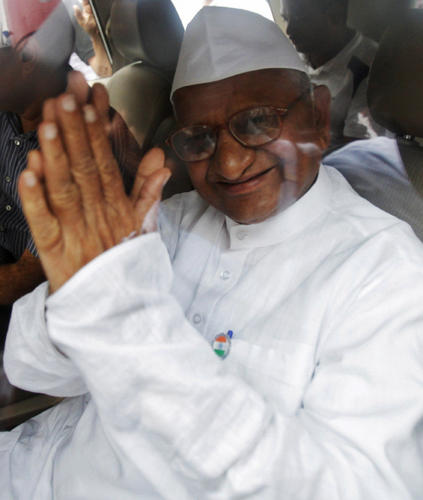
Veteran Indian social activist Anna Hazare gestures from a car after being
 detained by police in New Delhi Aug. 16, 2011. Hazare was arrested
by police on Tuesday to prevent him from launching a fast
 to the death to force the government to pass tougher
 anti-corruption laws.
NEW DELHI—Anna Hazare makes an unlikely hero in India. He is a 74-year-old bachelor who has made a career out of standing up to injustice and corruption, a campaign that ties him to one of the nation’s most revered leaders, Mahatma Gandhi.

Dressed in the signature white cap of his native Maharashtra state on the west coast of India, Hazare makes a stately figure, his crisp white clothes representing his calls for transparency while referencing Gandhi. His protest tactics from the Gandhian school of civil disobedience have reached into the consciousness of thousands, most of them youth.

Seated before a growing crowd at Jantar Mantar, the country’s protest headquarters in New Delhi, Hazare managed to pull off a significant coup: he pushed a faltering Indian government into a tight corner by first going on a hunger strike, then refusing to leave Tihar Jail, one of the country’s most notorious prisons, despite being freed by the government.

It’s a theatrical spectacle but one that has lured people across India who have become increasingly frustrated by the country’s lethargic, bloated and deeply corrupt structures.

Hazare and his followers are fighting to pass the long-delayed Jan Lokpal bill, first proposed in 1969, which would install an independent anti-corruption ombudsman.

“Think of Anna Hazare, Mr. Prime Minister,” wrote Shiv Visvanathan, a prominent Indian sociologist, in an open letter to Prime Minister Manmohan Singh on the website of an Indian news channel. “He is another mild man like you and today he stands for the ideals the Congress (Singh’s party) has forgotten. Let me list them: the dreams of honesty and idealism, the diligence that politics demands, and the intelligence that morality requires.”

But this Hazare wasn’t born to fight the system. Kisan Baburao Hazare was the eldest of seven children born to a labourer father and a homemaker mother in a small village in today’s Maharashtra state. The family later moved to Ralegan Siddhi, their ancestral village. Hazare achieved a seventh-grade education.

Hazare enlisted in the Indian army as a driver during the 1965 Indo-Pak war. He was driving a truck full of soldiers when two Pakistani jets attacked his platoon. Everyone died save Hazare, who was left to ponder why God had let him live.

He decided then that he was ready to sacrifice worldly pleasures for the betterment of his fellow Indians and started grassroots-level work by cleaning up his village. He launched an anti-alcohol campaign to combat the growing liquor intake in the village. That caused a dramatic drop in crime. He also developed a strong watershed program to teach villagers how to store rainwater and to raise the area’s quickly diminishing water table.

His efforts to transform Ralegan Siddhi from a dirt-poor village into an economically sustainable and efficient community earned Hazare the Padma Bhushan, the country’s third-highest honour.

Uplifting Ralegan Siddhi was just the beginning for Hazare. He has been a staunch agitator against corruption and has a zero-tolerance rule.

That’s made him a thorn in the side of the ruling Congress government, which has a long history of corruption scandals. Most recently, there were accusations that up to $1.8 billion was misappropriated from the 2010 Commonwealth Games.

Meanwhile, poverty remains a huge problem in India. Statistics show 46 per cent of children are malnourished. Four to five million don’t have access to water.

For Hazare, who has spent the past 45 years trying to address the daily burdens of India’s common people, these figures are unacceptable. Apparently plenty of young people agree.

Police Intervention Subdues Clash between Congress &BJP


Local BJP and Congress party workers were close to collide in a brawl when BJP was protesting outside the office of the collector in support of Anna Hazare and suddenly a few congressmen arrived on the scene and entered the collector’s office.


However, there arose some misunderstanding between the party workers when congress workers came there to celebrate with some of their elected candidates and BJP members misunderstood it to be an act to disturb their protest.


The scene turned ugly when congress workers fired cracker in front of the collectorate and entered into the compound. BJP workers raised their anger saying that how could they go inside the compound when they were not allowed to enter? Heavy police force with senior officials had taken the situation under control. At last congress workers left the area and BJP continued its protest against corruption.

Anna Hazare’s unstoppable wave of anti-corruption movement has covered every city and village of India pulling out millions of common masses from their work and home to join the cause.

However, some political parties also got a nice chance to grip the ruling party by supporting social activist and gandhian Anna Hazare. When it seems that the common Indian is taking a pledge to wipe out corruption from this country, still a few are taking the whole Anna episode as a favorable time to bake their cake.

The common Indian have to decide his fate now…who is going to rule him and how?

We will keep reporting.


Govt capitulates, Anna triumphs


Hazare ‘magic’ galvanised the nation and saw thousands of torch-and-Tiranga wielding “Annas” spilling onto streets of Delhi and across the country on Wednesday forcing the UPA Government to beseech Anna Hazare to come out of Tihar Jail and resume his peaceful fast in the Capital.

The capitulation was so clear that the legal eagles, who scripted Tuesday’s drama and dictated the litany of CrPC provisions that Anna was asked to sign before proceeding on fast, packed their law books and merged into the background. As reality dawned on the Government that the nation was solidly united behind Anna, the same regime was now ready to dump all its conditions and let the Gandhian go and fast wherever he wanted. Of course, no one was forthcoming to explain if the CrPC provisions were so sacrosanct that Anna had to be sent to jail for not agreeing to them, and how could they be dumped into dustbin so conveniently.

Leader of Opposition in the Rajya Sabha Arun Jaitley captured the Government’s helplessness succinctly when he told the House: “When you saw the magnitude of protests all over the country, you went begging to Hazare to come out of jail. He has scored over you due to his moral strength and now you are in a trap.”

Taking a dig at some of the Ministers, including Kapil Sibal and P Chidambaram, Jaitley said the “problem is that too many lawyers are advising the PM on political issues. You are using criminal procedure code to solve political problems.”

As day events unfolded, it was clear that the Government had no clear plan to deal with level of protest, which brought school and college students, sadhus, old men, fragile women, teachers, advocates, Government servants and aam admi on one platform. The dilemma was reflected in the Government’s confusing stance. So even as Delhi Police tried to persuade Anna to walk into freedom, the PM justified the decision to send him to Tihar and made a desperate attempt to pitch Parliament against Hazare.

While the BJP-led Opposition refused to accept the PM’s prognosis and slammed him for crackdown on Anna and his supporters, the crowd outside Tihar jail kept growing. As the day progressed, the Government was made to look like helpless spectators to the unfolding drama. By evening Anna Hazare and his team was dictating the terms and the Government pleading with them for a face-saver.

The man reviled as a leader of “anarchists” and “fascists” and thoroughly “corrupt” had suddenly become a “True Gandhian” for Home Minister P Chidambaram while Prime Minister Manmohan Singh had no qualms in admitting that Anna may have been inspired by high ideals.

Significantly, Congress spokesman Manish Tewari, who had heaped these scurrilous epithets on Anna was conspicuous by his absence both in the Lok Sabha and at the Congress headquarters.

It is a different matter that Tewari would not have reviled Anna without the consent of the party and the Government.

The Gandhian protest got a ‘spiritual dimension also as Sri Sri Ravishankar and Yoga guru Ramdev reached the Capital and slammed the Government for highhandedness. The fact that both of them have millions of supporters across the country and abroad was another element that clearly told the Government that if it continued with “arrogance’, more and more people were bound to come to the streets.

Whether it was Mumbai, where supporters of the Gandhian assembled at Azad Maidan or Bangalore, where thousands of students skipped classes and thronged Freedom Park, the nation seemed to tell the UPA Government that it will never allow it to even dream of revisiting Emergency and deprive citizens of their fundamental rights.

Jaipur, Patna, Kolkatta, Chennai, Ahmadabad, Bhopal, Indore, and all other important cities across the country saw a similar protest, unnerving the Government which was under the false impression that it could get away by meting out the Ramdev-treatment to Hazare as well.

As thousands of people begun to march towards India Gate in the evening and Anna magic united the nation, a panicky Government admitted in the Lok Sabha that the matter should have been handle politically and administratively. Though Chidambaram statement on this count will have few takers because it was well know that even on Tuesday he and his Ministry were directing the Delhi Police, it was an attempt to convince the nation that the Government will be more sensitive to handle such civil right movements in future. But the surge of people that marched towards India Gate should leave no doubt in the mind of the Government that its belated attempt to buy peace with Hazare have few takers among his followers.

Social groups ready for march to Delhi


JAIPUR: Social organisations in the city during a joint press conference on Wednesday announced that they were ready to march towards Delhi to support Anna Hazare.

Drawing similarities between the Emergency days and the protest today, the activists said the government "experimented with Emergency in 1975" but now it dare not repeat the same.

Rajasthan Samaj Sewa Sangh ex-president Sawai Singh said, "This time, the youths are participating in the protest against corruption in large numbers and they will certainly bring change."

They lashed out at the government for creating hurdles in Anna Hazare's protest. "Now, the government has started banning public protests. We condemn government's action of suppressing Hazare by arresting him," PUCL president Prem Krishna Sharma said.

The activists claimed that the Lokpal Bill which was presented in the Parliament was a mere "pile of papers". Jamat-e-Islami-Hind's state unit ex-president Salim Engineer said: "The government's Lokpal Bill is toothless. There should be a stronger Lokpal Bill to stop corruption. Public representatives are not rulers. They should behave like public representatives as they are accountable to common man who elected them."